
Geller vs Aurora Adjustable Height Desk: Which Tresanti Desk Wins for Your Workspace?
Choosing between our Geller and Aurora adjustable height desks comes down to more than just price. Both are Tresanti adjustable height desk models built on the same core lift technology, but they diverge sharply on workspace size, motor torque, integrated charging options, and daily usability.
If you've already narrowed your search to these two, you're likely weighing desktop real estate against feature density—and wondering whether the Geller's extra width justifies its premium or if the Aurora's compact footprint and power station tilt the decision. This guide walks through every functional difference that actually matters in daily use.

Desktop Dimensions and Workspace Layout
The Geller 47″ offers a full 47-inch-wide work surface, while the Aurora measures 47 inches as well but differs slightly in depth—Geller runs deeper at 23.6 inches compared to Aurora’s 23.5-inch profile. That half-inch depth difference is negligible in practice, but the real workspace difference shows up in how each desktop is cut and finished.
Geller’s edges use a beveled profile that sheds cable clutter more cleanly, where Aurora’s straight-cut edges sit flush against walls but catch loose cables more often. If you run dual monitors side-by-side or need space for a full-size keyboard tray plus a drawing tablet, both desks handle the width—but Geller’s bevel keeps the back edge cleaner when you’re routing power and display cables.
Neither model includes a built-in cable management tray in the base price, so plan on adding adhesive clips or a separate raceway if you’re running more than two devices. Desktop finish on both is laminate over engineered wood, rated for typical office use but not designed for wet spills or heavy abrasion.
Motor Strength and Lift Capacity
Both desks use the same dual-motor lift system rated at 225 pounds total capacity, which covers two monitors, a laptop dock, and typical desk accessories with room to spare. Motor noise during height transitions is identical—around 50 decibels at full speed, comparable to a quiet conversation.
Where they differ is transition speed under load. Geller’s motors are geared slightly lower, so it climbs from sitting to standing height about two seconds faster than Aurora when loaded near capacity. If you adjust height multiple times per day, that difference compounds—but if you set your preferred standing height once and leave it, both desks perform the same.
Our troubleshooting guide for desks that won’t lower covers the most common motor and sensor issues on both models, since they share the same control board. Collision-detection sensors are standard on each desk and stop the motors if the desktop meets resistance during movement, though neither model includes automatic obstacle detection on the upward travel.
Integrated Power and USB Charging
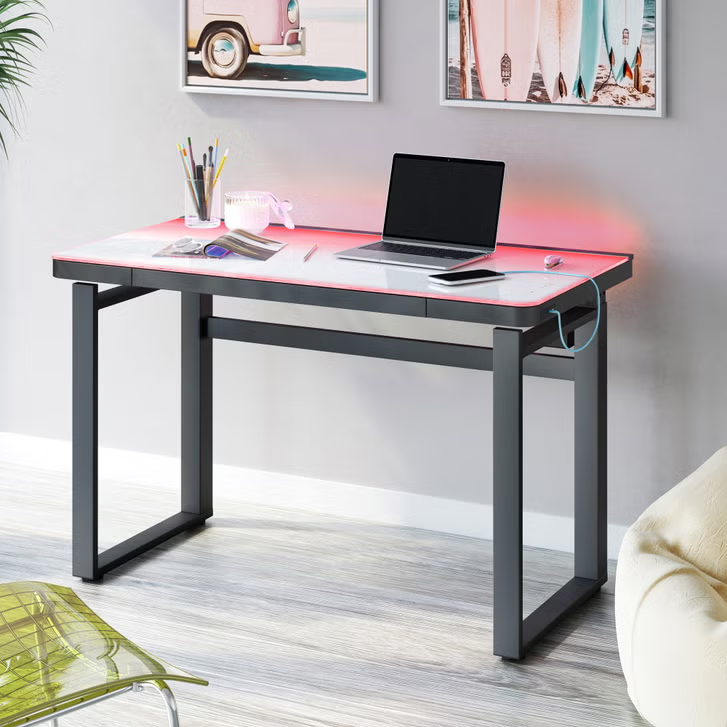
Aurora includes our built-in power station with two AC outlets and two USB-A ports mounted directly into the desktop surface. Geller ships without integrated power—you get a clean desktop but need to supply your own power strip or dock.
The Aurora’s power station draws from a single cord that routes down one leg, eliminating the need for a separate surge protector on the floor. Each USB-A port delivers 2.4 amps, enough to charge a phone or tablet at standard speed but not fast-charge compatible. The AC outlets are grounded and spaced wide enough for most laptop bricks, though oversized wall-wart adapters may block the second outlet.
Does the Power Station Add Desk Wobble?
No—the power module on Aurora mounts flush into a routed cavity in the desktop and adds no perceptible flex. Desktop rigidity on both models is identical when measured at full standing height, with about 0.3 inches of front-to-back wobble when pressed firmly at the edge. If you want to understand exactly how the charging system works without extra adapters, our detailed breakdown of Tresanti’s power station walks through the internal circuit layout.

Assembly Time and Installation Differences
Both desks ship in two boxes—one for the desktop, one for the frame and motors—and require about 45 minutes of assembly for one person with basic tools. The Geller frame uses eight bolts to attach the legs to the crossbar, where Aurora uses ten due to the added power-station cable routing bracket.
Neither desk requires drilling or permanent mounting to the wall, but both benefit from a stabilizer foot if placed on thick carpet. The control panel on each model mounts to the underside of the desktop via two screws and a snap-fit cable connector, so swapping the panel between desks isn’t possible without rewiring.
If you’re comparing the Geller in detail, the full specifications and assembly diagram are available on the Geller 47″ product page. Aurora’s slightly different frame geometry means the two desks don’t share leg assemblies, even though the motors themselves are interchangeable.
Memory Presets and Daily Usability
Both desks include a four-preset digital controller that stores your preferred sitting and standing heights. The controller is identical across models, with a backlit LCD that displays current height in inches and allows one-touch transitions to saved positions.
In practice, preset accuracy is within 0.1 inches after the desk has been in use for a week and the motors have seated. Initial setup requires manually adjusting to your preferred height, holding the memory button, then pressing a number—there’s no automatic calibration routine.
One common question: can you program intermediate heights for sitting on a stool or kneeling chair? Yes—all four presets are user-definable across the full 28.3-inch to 47.8-inch range. The desk doesn’t enforce which preset corresponds to sitting versus standing, so you can map all four to standing variations if that matches your workflow.
Matching Desk Features to Your Actual Workflow
Geller and Aurora both deliver on the core promise of a reliable Tresanti adjustable height desk—stable dual-motor lift, programmable presets, and a desktop wide enough for real work. The deciding factor is whether you value a clean surface with no built-in modules or prefer the convenience of integrated power that eliminates one cable run to the floor.
If you swap between sitting and standing multiple times per day and run several devices that need constant charging, Aurora’s power station simplifies cable management enough to justify its slightly higher price. If you already have a preferred power solution or want maximum flexibility to add your own charging dock, Geller’s uncut desktop gives you more control.
Neither desk is objectively better—they’re optimized for different setups, and both use the same lift platform that handles daily height changes without complaint. The OSHA ergonomics guidelines recommend alternating postures throughout the day regardless of which desk you choose, so whichever model you pick, plan on actually using the height adjustment rather than setting it once and leaving it.
Common Questions When Comparing Geller and Aurora Desks
No—the power station on Aurora is routed through a factory-cut cavity in the desktop and integrates with the frame's cable management during assembly. Retrofitting it to Geller would require drilling into the desktop and custom wiring, which voids the warranty.
If you need integrated power but prefer the Geller's other features, plan on using a clamp-on power strip or a separate charging dock.
Both Geller and Aurora support dual monitors up to 27 inches each, provided total weight stays under 225 pounds. The desks share the same width and depth, so monitor placement is identical.
The difference shows up in cable routing—Geller's beveled back edge makes it slightly easier to drop cables behind the desk without them catching on the edge. Aurora's built-in power station reduces the number of cables that need to reach the floor, which can simplify the overall setup even though the desktop edge is less forgiving.
No—the power module adds negligible weight and doesn't affect motor performance. Both desks use the same lift mechanism and achieve the same speed under equivalent loads.
The only functional difference is that Aurora requires routing one additional power cable down the leg during assembly, which takes about two extra minutes but doesn't impact daily operation.
You can, but expect increased wobble at standing height on carpet thicker than half an inch. Both Geller and Aurora use the same leg-foot design, which spreads load well on hard floors but sinks slightly into plush carpet.
Adding aftermarket stabilizer feet—available from most office furniture suppliers—reduces front-to-back wobble by about 40 percent on thick carpet. The desks don't ship with these feet, so budget for them separately if your workspace has deep-pile flooring.
They produce identical noise levels—around 50 decibels—because they share the same motor and gearing. The sound profile is a low hum during movement, not a grinding or clicking noise.
If motor noise is a concern in a shared workspace, both desks are quiet enough for use in open offices without drawing attention during transitions.
Motors, control boards, and height sensors are interchangeable between the two models. Desktop surfaces and power-station modules are not—Aurora's desktop is factory-routed for the integrated power station, so you can't swap it onto a Geller frame.
For most wear items—motors, cables, control panels—parts are shared, which simplifies long-term maintenance and keeps replacement costs consistent across both desks.